Thursday, March 19, 2020

Orpheus & Hope


It’s been awhile since I typed on this blog.  I have a bit more time now…as school is on hiatus because of the Coronavirus.  I’ve been gardening and reading, grading and planning for online school, practicing “Sweet Home Alabama” on the guitar and working out with Heather Robinson’s free 12 week challenge (you should join me :)).  I’ve been trying to learn new things – and tonight as I watched another TED-Ed video on “Myths from Around the World”, I saw the story of Orpheus and Eurydice. 

Let’s be real for a moment.

Greek myths are RIDICULOUS.  (We can be glad that Greek gods are myths and not real beings). 

But as with any story, we can learn.

Here’s the myth in short:  Orpheus falls in love with Eurydice.  Right before they get married, she dies.  Orpheus decides to go get her back from the underworld and uses his amazing ability to sing to get past the 3-headed dog, over the river Styx, and ultimately to convince Hades to let her go.  The catch?  He has to walk out of the underworld without looking back, trusting that Eurydice is following.  And just before he makes his final steps…he looks back.

Rats.

Now, you may be thinking…I know this story!  Isn’t there a newer Broadway musical about it?  Well, you are more with it than me, because as I scrolled down to see the comments on this YouTube video – Hadestown was all anyone was talking about.  So, like any good internet user, I did some searching. 

I now have read the Wikipedia synopsis and listened to quite a few of the songs.  And, I would have to say that Orpheus and Hadestown put some things into perspective for me.  Like any good story, they took me deeper into life and reminded me of truth.

Hadestown does not follow the original myth exactly, but it does still have that shocking ending.  Instead of the hopeful reunion of Orpheus and Eurydice, it ends with a gasp and a separation as Orpheus turns at the last moment and dooms Eurydice back to Hades.

In the song, Road to Hell (Reprise), the cast slowly sings:
It’s an old song
It’s an old tale from way back when
It’s an old song
And that is how it ends
That’s how it goes.
Don’t ask why, brother, don’t ask how
He could have come so close
The song was written long ago
And that is how it goes
It’s a sad song
It’s a sad tale
It’s a tragedy
It’s a sad song
But we sing it anyway
Cause here’s the thing
To know how it ends
And still begin to sing it again
As if it might turn out this time
I learned that from a friend of mine:
See, Orpheus was a poor boy
But he had a gift to give
He could make you see how the world could be
In spite of the way that it is

Ooh.  What a line.  He could make you see how the world could be in spite of the way it is. 

Our world can be so beautiful.  But, sometimes, what we see around us is tragedy.  I’m not just talking about deaths from COVID-19 or the potential economic consequence of social distancing and government shut-downs.  I’m talking about broken relationships, broken homes, devasting natural disasters, uncertainty, fear, confusion, etc. 

But what if, my friends, there is more to the world than what we see?  Is this sadness all there is?

To quote some other fictional stories:

What if Samwise Gamgee was right when he said: 

“Gandalf!  I thought you were dead!  But then I thought I was dead myself.  Is everything sad going to come untrue?  What’s happened to the world?”  
(Tolkien, The Return of the King)

What if Emily was right? 

“It had always seemed to Emily, ever since she could remember, that she was very, very near to a world of wonderful beauty.  Between it and herself hung only a thin curtain; she could never draw the curtain aside – but sometimes, just for a moment, a wind fluttered it and then it was as if she caught a glimpse of the enchanting realm beyond – only a glimpse – and heard a note of unearthly music.”
(LM Montgomery, Emily of New Moon)

I believe the fictional stories of Orpheus & Eurydice, Sam, and Emily all strike a chord in me because they are a hint of a Greater Story.

In that Story, a powerful God created a perfect world.  Being a gentleman, He allowed his creatures to choose to follow Him or not.  When they chose to reject Him and rebel, the world became broken.  That brokenness showed up in a myriad of ways (broken relationships, natural disasters, horrible diseases).  However, this God refused to watch His creatures suffer without doing something about it.  He ENTERED His created world, took on His creatures’ form and consequences for their own rebellion, and made a way for all the sad things to be made untrue.  Simply by re-submitting to His Lordship and accepting His gift, His creatures could be restored to relationship with Him!  This God ultimately defeated death so that death was no longer the end! Yet, this God did not completely destroy all evil right away.  He knew that some of His creatures (who themselves were evil) would choose Him in time.  So, currently, His followers are left waiting to be united with the God of infinite beauty and kindness.  While they wait, they sing His songs, in the hope that others may choose to follow Him as well.

If this story is true, fictional Sam’s wish is granted – sadness will be defeated.
If this story is true, fictional Emily has sensed what is REAL – beauty beyond this world that she one day gets to join.
If this story is true, fictional Orpheus could bring people hope by singing  - not of a world he wished was true, but of world where each story can have an happy ending.

My friends, I believe with all my heart that this Great Story is not fictional at all.  It is found in the Bible and gives us HOPE in the midst of tragedy and uncertainty.  The hero of this story is not some narcissistic Greek god, but the Son of God:  Jesus Christ. 

The very last song of Hadestown is called “We Raise Our Cups”
“…some birds sing when the sun shines bright – our praise is not for them.
But the one who sings in the dead of night – we raise our cups to them.
Some flowers bloom where the green grass grows – our praise is not for them.
But the ones who bloom in the bitter snow – we raise our cups to them.”

It’s hard to sing in the dead of night and the bitter snow...unless you have hope.

Orpheus, for all his beautiful singing, failed to save Eurydice and was left to live life without her.
It doesn’t matter how many times we sing this song or watch Hadestown…Orpheus will still turn back.

But in the Greater Story, Jesus takes on the cross and wins back those He loves!

If you know Jesus as your Savior – may you be like Orpheus, singing with a song more beautiful than any earthly stain of music – so that other people seek to know the Great Story.
If you don’t know Jesus as your Savior – may I implore you to read His story and see if it’s true?  I’d love to talk to you about the hope it can bring you.

Because it’s not a myth about a failing hero.
It’s a story about forgiveness and love.
And it’s TRUE.


Sunday, January 20, 2019

Cantus Firmus


Great Heart was my theme of last year.  And it wasn’t until June that I was reminded of the fact that for all of my trying, God is the one who gives me a great heart.  Psalm 119:32 says, “I will run in the path of your commands when you enlarge my heart!”  What a freeing thought!

As I sat on my porch, drinking my tea and reading back through my journal this afternoon, I realized that God has expanded on this theme of “Great Heart” throughout this school year.  This year, He has repeatedly to told me to sing.

“You turned my wailing into dancing, you removed my sackcloth and clothed me with joy, that my heart may sing to you and not be silent.  O LORD my God, I will give you thanks forever.”  Psalm 30:11-12

It started back in July, when I read about the cantus firmus.  I had just gotten through sharing with friends some of my favorite Latin phrases (carpe diem, carpe aeternitatem, coram deo…) and this appeared in my inbox as the daily Slice of Infinity from RZIM.  A new Latin phrase!  Woot! :)

Here a few direct quotes from what Jill Carattini said:
·       The cantus firmus, which means "fixed song," is a pre-existing melody that forms the basis of a polyphonic composition. Though the song introduces twists in pitch and style, counterpoint and refrain, the cantus firmus is the enduring melody not always in the forefront, but always playing somewhere within the composition. 
·       "God wants us to love him eternally with our whole hearts, not in such a way as to injure or weaken earthly life, but to provide a kind of cantus firmus to which the other melodies of life provide the counterpoint... Where the cantus firmus is clear and plain, the counterpoint can be developed to its limits." (Dietrich Bonhoeffer, Letters & Papers from Prison, p. 303)
·       For Dietrich Bonhoeffer, life was a great work of sounds and symphonic directions, and the cantus firmus was the essence, the soul of the concerto.

Ooh.  So good.  I love that musical analogy even thought I am not a trained musician by any stretch of the imagination. 
***Dietrich Bonhoeffer wrote many books, but was able to use music as an analogy to the Christian life because he knew it well.  At one point it was thought that he would become a professional musician because of his skill at playing the piano.***

After reading Bonhoeffer’s words, in my journal I pondered: “In a great heart – what is the heart’s song?” 

Is my heart singing a cantus firmus on which to base my whole life around? 
And how do I get a good cantus firmus?

As I continued to read my journal, I saw God repeatedly reminding me that the way to a Great Heart and a beautiful cantus firmus is time in His Word, discovering more about His character. 

I recently read more about two women who allowed their knowledge of God to come out in beautiful expressions of worship:

1.     Fanny Crosby was born in 1820 with sight, but her eyes were blinded in infancy after a well-meaning doctor mistreated an eye infection.  She had limited physical vision but was blessed with incredible spiritual insight.  Part of that insight came from the work of her grandmother, Eunice, and Mrs. Hawley, the Crosby’s landlady.  Both women were committed to helping Fanny memorize the Bible as they read verses to her and reviewed chapters.  With their help Fanny memorized the Pentateuch (Genesis, Exodus, Leviticus, Numbers, Deuteronomy), the four Gospels, most of the Psalms, all of Proverbs and other portions of the Bible.  No wonder she could write more than 8,000 hymns in her 95 years!  What she filled up with flowed out of her heart.  For example:
I think of my blessed Redeemer,
I think of Him all the day long:
I sing, for I cannot be silent;
His love is the theme of my song
.
Redeemed, redeemed,
Redeemed by the blood of the Lamb;
Redeemed, redeemed,
His child and forever I am.
I know I shall see in His beauty
The King in whose law I delight;
Who lovingly guardeth my footsteps,
And giveth me songs in the night.

2.     Catherine of Siena was born in Italy in 1347, and although she only lived for 33 years, she dictated 380 letters, 26 prayers and 4 treatises.  Yet again, a Slice of Infinity from Jill Carattini in October made my mind think on this more:
a.     “In Catherine’s prayers, the editor notes, ‘Her theology becomes her doxology.’  Namely, what Catherine professed to be true about God became in her prayers – and arguably in her life – an expression of praise to God.  It struck me as a beautiful notion – what we know of God being something that moves us to sing to God.  And then I was quieted by a thought:  Shouldn’t all theology naturally lead us to doxology?”
b.     “What do you know about God?  What have you seen of God’s character and known of God’s goodness?  Might this theology become a song worth singing.  In your knowledge of God and in your knowing of Christ, might you find in word and deed, in prayer and song, your life a doxology to the goodness of a Creator who wants to be known.” 

Both Fanny and Catherine allowed what they knew of God to be displayed in their lives.  Their theology became doxology…and an offering of praise to their great God.

Is my heart so filled with Christ that like Fanny Crosby I can say, “I sing for I cannot be silent, His love is the theme of my song”?

He is The Cantus Firmus. 

He is the fixed song.

And only when He is the enduring melody of my heart can all of the other melodies find their proper place.

“Ever since you rescued me,
You gave my heart a song to sing
I’m living for the world to see
Nobody but Jesus.”
– Casting Crowns/Matthew West

Monday, January 15, 2018

Elijah's Last Lesson

“The God who made the world and everything in it is the Lord of heaven and earth and does not live in temples built by hands.  And he is not served by human hands, as if he needed anything, because he himself gives all men life and breath and everything else.  From one man he made every nation of men, that they should inhabit the whole earth; and he determined the times set for them and the exact places where they should live.  God did this so that men would seek him and perhaps reach out for him and find him, though he is not far from each one of us.  ‘For in him we live and move and have our being.’  As some of your own prophets have said, ‘We are his offspring.’”
~ the apostle Paul, speaking in Athens (Acts 17:24-27)

In America, we have set aside today to commemorate Martin Luther King, Jr. – someone who called on all of us, Christians especially, to recognize the truth that all men are created equal.  I had the privilege of reading “Letter from a Birmingham Jail” earlier this year, and found it very convicting.

I am so grateful for people who are willing to stand up and speak truth in a world that so often refuses to listen.  King spoke about the truth contained in the verse above:  God has made all men from one man, showing our equality.  We are precious because we are made in God’s image.  He cares about each one of us.  As the verse goes on to say, he even cares about the times and places in which we live. 

Location matters.
History matters.

The other day I listened to a series of talks on the life of the prophet Balaam by Ravi Zacharias.  The talks were very good, but what stuck out to me was a side comment he made about the calling of Elisha.  And, again, I was struck with the fact that places…and history…are important.

In 2 Kings 2 in the Bible, we are told that God is about to miraculously take Elijah up to heaven.  Elijah and Elisha are just coming from Gilgal when Elijah tells Elisha to stay while he goes on to Bethel.  Elisha is not easily dissuaded and follows Elijah to Bethel.  While in Bethel, Elijah tells Elisha to stay while he goes to Jericho, and Elisha again refuses to leave his master.  In Jericho, Elijah tries to leave Elisha behind again while he journeys to the Jordan, and still…Elisha stays with Elijah.  They reach the Jordan, Elijah miraculously separates the Jordan River by striking it with his cloak, Elisha asks to inherit a double portion of Elijah’s spirit, and Elisha sees Elijah taken up into heaven by a chariot and horses of fire. 

Wow, eh?  We see what seems to be a random assortment of trips…Gilgal, Bethel, Jericho, the Jordan…almost as if Elijah is trying to either lose Elisha…or test him.  But it appears that Elijah was giving Elisha one last lesson about God before Elijah handed his job off to his apprentice.

What happened at each of these locations?
1.       Gilgal:  In Joshua 4, the Israelites miraculously cross the Jordan River on dry ground, entering the promised land for the first time.  One man from each of the twelve tribes of Israel picks up a stone from the middle of the river bed, and after they cross, they place these stones in a memorial at the first place they camp:  Gilgal.
a.       At this same place, God also asks the Israelites to be circumcised, recommitting to their covenant with God by doing what they had neglected to do while they wandered in the wilderness.  Gilgal sounds like the Hebrew word for “roll”, and it was there that they respected God’s holiness by following his commands, and it is said that God “rolled away the reproach of Egypt” from the Israelites at Gilgal.
2.       Bethel:  Bethel means “house of God,” and any good Israelite would remember that:
a.       Abraham pitched his tent west of Bethel (Genesis 12:8)
b.       Abraham first built an altar to the Lord at Bethel (Genesis 13:3-4)
c.       Jacob dreamed of the ladder/stairway to heaven, and God promised to give him the land and be with him at Bethel (Genesis 28:10-22)
d.       God told Jacob to settle in Bethel and to build an altar there (Genesis 35:1-7)
e.       Jeroboam set up a golden calf as an idol in Bethel for Israel to worship (I Kings 12:28-29).
3.       Jericho:  In Joshua 5:13ff, after the Israelites crossed over the Jordan and were circumcised, they see the power of God as the highly fortified city of Jericho comes tumbling down after 7 days of silently walking around the city (Joshua 5:13ff).  It is completely miraculous, because all the people do is walk, play trumpets, and shout – and the wall comes down! 
4.       Jordan:  the Jordan River was such a big part of the landscape of Israel, connecting the Sea of Galilee and the Dead Sea, separating the nation of Israel as it traveled North to South.  God splits the Jordan River in Joshua 3 as the priests step out in faith into the flood-stage river…and the people walk over on dry ground.  And, in 2 Kings 2, Elijah strikes the water with his cloak and the river splits.

How could I have missed this before?  Ravi mentioned that Elijah was reminding Elisha of God’s holiness at Gilgal, his faithfulness at Bethel, and his power at Jericho.  It wasn’t until I read up on those places that I understood what he meant. 

Elisha would have seen the 12 stones commemorating the crossing of the Jordan and through the name Gilgal remembered the circumcision that took place there to please a holy God. 

He would have seen the altars and recognized the faithfulness of God even when Israel turned away to idol worship. 

He would have seen the still fallen walls of Jericho, not rebuilt: a testament to the miraculous power of the God he served. 

And when Elisha got to the Jordan?  How could he miss the lesson there? 

God used sandals of men walking in faith to split that river in Joshua 3.
God used the rocks from the middle of the river to remind the Israelites of who He was and what he could do in Joshua 4.
God used the cloak of a prophet to split the river in 2 Kings 2.

Inanimate objects could be used to give glory to God.  Because it wasn’t the inanimate objects themselves, but the God behind them.

As Ravi said, “Even stones can be a testimony for God…how much more a person empowered by God?”

So, on this day commemorating American history, I think it’s good to go back to Biblical history as well and realize God cares about the times and places in which we live. 

He cares about the places He leads us to and through, if only momentarily. 

If we look and listen closely, I think we can’t help but hear the testimonies of those who have gone before us, pointing to a God who made the world and everything in it.  A God who is not far from any one of us.  A holy God.  A faithful God.  A miraculously powerful God.  A God who desires that we should reach out and to seek Him.  And a God who is willing to use the simplest things to share his truth and grace with others…even Christians…if we’re up for the challenge. 


As God used Elijah to show Elisha, all we might need as impetus is a short history lesson. 

Monday, January 1, 2018

Great Heart

In C.S. Lewis’s The Voyage of the Dawn Treader, Lucy Pevensie called out for Aslan’s help when she and her shipmates were surrounded by thick, distressing darkness.  A beam of light appeared, and “Lucy looked along the beam and presently saw something in it.  At first it looked like a cross, then it looked like an aeroplane, then it looked like a kite, and at last with a whirring of wings it was right overhead and it was an albatross.  It circled three times round the mast and then perched for an instant on the crest of the gilded dragon at the prow.  It called out in a strong sweet voice what seemed to be words though no one understood them.  After that it spread its wings, rose, and began to fly slowly ahead, bearing a little to the starboard.  Drinian steered after it not doubting that it offered good guidance.  But no one except Lucy knew that as it circled the mast it had whispered to her, ‘Courage, dear heart,’ and the voice, she felt sure, was Aslan’s, and with the voice a delicious smell breathed in her face” (p. 159-160).

That image of whispered encouragement has always been precious to me. 

Aslan, as the Christ-figure in the Chronicles of Narnia books, whispered “Courage, dear heart” to his beloved daughter in darkness.  How often I need to be reminded of that very same thing – that no matter where I go and no matter what I do, I am dear to the heart of God.  Because of that, I can have courage.

The old hymn puts it well: 
So nigh, so very nigh to God,
I cannot nearer be;
For in the person of His son
I am as near as He.

So dear, so very dear to God,
More dear I cannot be
The love wherewith He loves the Son
Such is His love to me.

~ C. Paget (A Mind at Perfect Peace with God)

This past September, God saw fit to give me another heart reference as my theme for the new school year.  But it wasn’t an albatross whispering.  This time, it was a wizard speaking to a horse.  :)

I admit:  until this past September, I had put off reading the Lord of the Rings trilogy.  But I fell in love with them!  J.R.R. Tolkien has written so many quotable lines and come up with many analogies that help me to go deeper into my own life.  But, laughably, the most impactful quote for me was on page 262 of the Two Towers, where Gandalf says:

“Away now, Shadowfax!  Run, greatheart, run as you have never run before!  Now we are come to the land where you were foaled, and every stone you know.  Run now!  Hope is in speed!”

Thank you, Pinterest.  Definitely not my picture.

Great heart.

Horses have really big hearts.  No, really.  At 1% of their body mass, we’re talking about 9-12 pounds of pure muscle, pumping the needed oxygenated blood to the rest of the body for peak performance.  Partly from genetics and partly from training, the thoroughbred racehorses are known to have the largest hearts of all horses.  Phar Lap (from New Zealand) had a 14-pound heart, and it is believed that Secretariat’s might have been even bigger.  (Comparatively, human hearts are 0.5-0.8 pounds.)

Although Shadowfax was a horse, the encouragement from Gandalf to run and the name he was given spoke of more than the physical size of his heart.  “Greatheart” also spoke of Shadowfax’s noble character.  (You can’t read the books and not be impressed by Shadowfax, let alone not wish that he was your horse.)

Now, run with me on this… (see what I did there? :))

I can always imagine God whispering to me, “Courage, dear heart.”  I know that I will always be dear to the heart of God. 

But being called “Great heart”?  That’s a very different thing.  Being a “great heart” is not a guarantee.  It is the result of my choices.

My title of Dear Heart is dependent on God.  The title of Great Heart is dependent on me.

What would it look like this year to have a Great Heart? 
Could it be helped by:
·       A good cleaning?
o   emptying me of myself so that God has more room to work in my life?
o   clearing out the junk (or even good things that aren’t best) that so often fills my heart?
·       A bigger perspective?
o   caring about God’s plans more than my own?
o   considering others better than myself and serving in humility?  (Philippians 2:3ff, Mark 10:43)
·       More exercise?
o   the more I practice living for God and not for me, the more my heart might expand. (I mean, really – Dr. Seuss said the Grinch’s heart grew three sizes when he stopped being selfish. :))

Why is having a Great Heart so important? 

“For this reason I kneel before the Father from whom his whole family in heaven and on earth derives its name.  I pray that out of his glorious riches he may strengthen you with power through his Spirit in your inner being, so that Christ may dwell in your hearts through faith.  And I pray that you, being rooted and established in love, may have power, together with all the saints, to grasp how wide and long and high and deep is the love of Christ, and to know this love that surpasses knowledge – that you may be filled to the measure of all the fullness of God.”  Ephesians 3:14-19

Christ dwells in my heart. 

Does He feel at home there?  As Jonathan Brower asked a few weeks ago at my church, “In my life, is God’s presence dwelling where He wants to dwell?”

It sure seems like pursuing a great heart is a worthy goal this year.  I know that at times I will fail in my pursuit, but thankfully God is greater than my heart (I John 3:18-20). 

However, feel free to join me this year in praying that God would increase our hearts. 

That way, we can listen for the whisper of “Courage, Dear Heart,” knowing that He is speaking to us…

As well as…“Continue, Great Heart,” as we run in the paths and places in which He has presently called us to be.

“Now to him who is able to do immeasurably more than all we ask or imagine, according to his power that is at work within us, to him be glory in the church and in Christ Jesus throughout all generations, for ever and ever!  Amen.” 

Ephesians 3:20-21

Sunday, March 12, 2017

The Old, Old Story

Arabella Katherine (Kate) Hankey was born in 1834 and grew up in a neighborhood in the south of London called Clapham.  The people of Clapham were known for pushing for prison reform, children's education, and missionary overseas efforts.  William Wilberforce is one of the most famous members of the "Clapham Sect".

From a young age, the story of the gospel gripped Kate.  She taught Sunday school classes, organized Bible studies for girls in London, and donated many of her proceeds from her writing to missionaries overseas.  She wanted people to know the Old, Old Story.

While she was sick and confined to bed for a full year, she wrote a poem entitled:  "The Old, Old Story."  A few hymns have been written using her words: "Tell Me the Old, Old Story" by William Doane and "I Love to Tell the Story" by William Fischer.  

I read this poem this morning...and although it is long, it is worth repeating.  I have also put the links below showing where I found the words.  I hope it is a blessing to you like it has been to me! :)
***I also put in bold the words that really touched me.***

The Old, Old Story by Kate Hankey
(for a PDF version of the 1875 printed edition, click here)

Part 1—The Story Wanted
Tell me the old, old story
  Of unseen things above,—
Of JESUS and His glory,
  Of JESUS and His love.
Tell me the story simply,
  As to a little child;
For I am weak and weary,
  And helpless and defiled.
Tell me the story slowly,
  That I may take it in,—

That wonderful redemption,
  God's REMEDY for sin!
Tell me the story often,
  For I forget so soon!
The "early dew" of morning
  Has passed away at noon!
Tell me the story softly,
  With earnest tones and grave;
Remember, I'm the sinner
  Whom Jesus came to save.
Tell me the story always,
  If you would really be,
In any time of trouble,
  A comforter to me.
Tell me the same old story
  When you have cause to fear
That this world's empty glory
  Is costing me too dear.
Yes, and when that world's glory
  Shall dawn upon my soul,
Tell me the old, old story,
  "CHRIST JESUS MAKES THEE WHOLE."
Part 2—The Story Told
You ask me for "the story
  Of unseen things above,—
Of JESUS and His glory,
  Of JESUS and His love."
You want "the old, old story,"
  And nothing else will do!
Indeed I cannot wonder,
  It always seems so new!
I often wish that some one
  Would tell it me, each day;
I never should get tired
  Of what they had to say.
But I am wasting moments!
  Oh, how shall I begin
To tell "the old, old Story,"
  How Jesus saves from sin?
Listen, and I will tell you;
  God help both you and me,
And make "the old, old story"
  His Message unto thee!
Once, in a pleasant garden,
  God placed a happy pair;
And all within was peaceful,
  And all around was fair.
But oh! they disobeyed Him!
  The one thing He denied
They longed for, took and tasted;
  They ate it, and—they died!
Yet, in His love and pity,
  At once the Lord declared
How man, though lost and ruined,
  Might after all be spared!
For one of Eve's descendants,
  Not sinful, like the rest,
Should spoil the work of Satan,
  And man be saved and blest!
[He] should be son of Adam,
  But Son of God as well,
And bring a full salvation
  From sin and death and hell.
Hundreds of years were over;
  Adam and Eve had died,
The following generation,
  And many more beside.
At last, some shepherds, watching
  Beside their flocks at night,
Were startled in the darkness
  By strange and heavenly light.
One of the holy angels
  Had come from Heaven above,
To tell the true, true story,
  Of Jesus and His love.
He came to bring "glad tidings,"
  "You need not, must not, fear;
For Christ, your new-born Saviour,
  ;Lies in the village near!"
And many other angels
  Took up the story then—
"To God on high be glory,
  Good-will and peace to men."
And was it true—that story?
  They went at once to see,
And found Him in a manger,
  And knew that it was He.
He whom the Father promised,
  So many ages past,
Had come to save poor sinners;
  Yes, He had come at last!
That was indeed His purpose,
  To seek and save the lost,
Although He knew beforehand—
  Knew all that it would cost.
He lived a life most holy;
  His every thought was love,
And every action showed it,
  To man, and God above.
His path in life was lowly,—
  He was a working-Man:
Who knows the poor man's trials
  So well as Jesus can?
His last three years were lovely!
  He could no more be hid;
And time and strength would fail me
  To tell the good He did
.
He gave away no money,
  For He had none to give;
But He had power of healing,
  And made dead people live.
He did kind things so kindly!
  It seemed His heart's delight
To make poor people happy,
  From morning until night!
He always seemed at leisure
  For every one who came;
However tired or busy,
  They found Him just "the same."
He heard each tale of sorrow
  With an attentive ear.
And took away each burden
  Of suffering, sin, or fear.
He was "a Man of Sorrows!"
  And when He gave relief,
He gave it like a brother,
  Acquainted with the grief.
Such was "the Man Christ Jesus!"
  The Friend of sinful man!—
But hush! the tale grows sadder,
  I'll tell it—if I can!
This gentle, holy Jesus,
  Without a spot or stain,
By wicked hands was taken,
  And crucified, and slain!
Look! look! if you can bear it—
  Look at your dying Lord!
Stand near the cross and watch Him:
  "Behold the Lamb of God!"
His Hands and Feet are piercèd,
  He cannot hide His Face;
And cruel men stand staring,
  In crowds, about the place.
They laugh at Him and mock Him!
  They tell Him to "come down,"
And leave that cross of suffering,
  And change it for a crown.
Why did He bear their mockings?
  Was He "the Mighty God?"
And could He have destroyed them
  With one almighty word?
Yes, Jesus could have done it;
  But let me tell you why
He would not use His power,
  But chose to stay and die.
He had become our "Surety;"
  And what we could not pay,
He paid instead, and for us,
  On that one dreadful day.
For our sins He suffered;
  For our sins He died;
And "not for ours only,"
  But "all the world's" beside!
And now, the work is "finished!"
  The sinner's debt is paid!
Because on "Christ the Righteous"
  The sin of all was laid.
Oh, wonderful redemption!
  God's remedy for sin!
The door of heaven is open,
  And you may enter in!
For God released our "Surety,"
  To show the work was done;
And Jesus' resurrection
  Declared the victory won!
And now, He has ascended,
  And sits upon the throne,
"To be a Prince and Saviour,"
  And claim us for His own.
But when He left His people,
  He promised them to send
"The Comforter," to teach them,
  And guide them to the end.
And that same Holy Spirit
  Is with us to this day,
And ready now to teach us
  The "new and living way."
This is "the old, old story!"
  Say, do you take it in—
This wonderful redemption,
  God's remedy for sin?
Do you at heart believe it?—
  Do you believe it's true,
And meant for EVERY SINNER,
  And, therefore, meant for you?
Then take this "GREAT SALVATION"
  [For] Jesus loves to give!
Believe! and you receive it!
  Believe! and you shall live!
And if this simple message
  Has now brought peace to you,
Make known "the old, old story,"
  For others need it too.
Let everybody see it,
  That Christ has made you free;
And if it sets them longing,
  Say, "Jesus died for thee!"
Soon, soon, our eyes shall see Him!
  And, in our home above,
We'll sing "the old, old story"
  Of "Jesus and His love!"

Sunday, January 8, 2017

Glory & Awe

“When with the ransomed in glory, His face I at last shall see
Twill be my joy through the ages to sing of His love for me…
How wonderful!  How marvelous!  And my song shall ever be:
How wonderful!  How marvelous is my Savior’s love for me!”
-          C.H. Gabriel


Ever have a theme for the year without even realizing it?  It seems that the Lord has been patiently teaching me many lessons over the past year…but it wasn’t until I sat down and really processed through that it all started to come together.  I’m sure that I’m still missing the full lesson.  And I know that you don’t have time to read all of the things I’ve thought about today.  :)  But let me try to share a little.

I had the privilege of listening to two live performances of Handel’s Messiah this past Christmas season.  I don’t think I’ve ever listened to it in full before.  Sure, I could sing parts of the Hallelujah chorus and recognized the “Wonderful!  Counselor!” section…but I hadn’t listened to more.  I was struck with a few things as I listened to the words taken right from the Bible.
1.       “Behold!” – how often the prophets talked of His coming…and said to LOOK.
a.       “The Lord, whom you seek, shall suddenly come into His temple, even the messenger of the covenant, whom you delight in; behold, He shall come, saith the Lord of Hosts” (Malachi 3:1-3).
b.      “O Thou, that tellest good tidings to Zion, get thee up into the high mountain.  O Thou that tellest good tidings to Jerusalem, lift up they voice with strength, lift it up, be not afraid; say unto the cities of Jerusalem: ‘Behold your God!’ (Isaiah 40:9).
c.       “Rejoice greatly, O daughter of Zion; Shout, O daughter of Jerusalem.  Behold, thy King cometh unto thee…” (Zechariah 9:9-10).
2.        “Glory” came up frequently.  (and many times when the chorus joined the soloists)
a.       “And the glory of the Lord shall be revealed, and all flesh will see it together” (Isaiah 40:5).
b.      “Arise, shine, for thy light is come, and the glory of the Lord is risen upon thee.  For behold darkness shall cover the earth, and gross darkness the people.  But the LORD shall arise upon thee, and His glory shall be seen upon thee” (Isaiah 60:1-2).
c.       “There were shepherds abiding in the field, keeping watch over their flocks by night.  And lo, the angel of the Lord shone round about them, and they were sore afraid.  And the angel said unto them:  Fear not, for behold, I bring you good tidings of great joy, which shall be to all people.  For unto you is born this day in the city of David a Savior, which is Christ the Lord…And suddenly, there was with the angel, a multitude of heavenly host, praising God and saying:  ‘Glory to God in the highest and peace on earth, goodwill towards men’” (Luke 2:8-11, 13-14).
3.       God is so far above us. He is awe-inspiring.
a.       “The Lord, whom you seek, shall suddenly come into His temple, even the messenger of the covenant, whom you delight in; behold, He shall come, saith the Lord of Hosts.  But who may abide the day of His coming, and who shall stand when He appeareth?” (Malachi 3:1-3)
b.      “Hallelujah!  For the LORD God Omnipotent reigneth...The kingdom of this world is become, the kingdom of our Lord and of His Christ.  And He shall reign forever and ever…King of Kings and Lord of Lords”  (Revelation 19:6, 16; 11:15).

Beholding.  Glory.  The utter power and beauty of God.

Isn’t it ironic that when I spoke at a women’s conference in April, my title was “Beholding is Becoming” – and my talk centered around II Corinthians 3:18, “And we, who with unveiled faces all reflect (behold) the Lord’s glory, are being transformed into His likeness with ever increasing glory, which comes from the Lord, who is the Spirit.”

What we spend our time looking at, we become like.  I told the Lord I wanted to behold Him…I wanted to become more like Him.  And that takes time...metamorphosis is not pretty in all its stages.  It’s a process of ever increasing glory.  And I will never be God (thank goodness!), but I can more clearly bear His image to those around me.  What helps that process is having a clearer vision of who He is.

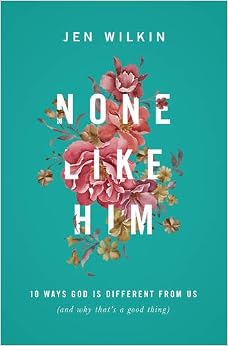
My vision of God has been helped through more Bible reading for sure.  But I also finished a book today that I found earlier this week.  (I have a slight problem when it comes to books.  I love them.  I order them before I finish the ones I am in the midst of reading.)  When I came home a week ago, I found myself on Amazon, looking at new titles…and I was captured by one I had never heard of:  None Like Him:  10 Ways God is Different From Us (and why that’s a good thing) by Jen Wilkin.


I would highly encourage you to read it.  Jen reminds us that God is:
1.       Infinite – The God of No Limits
a.       He is immeasurable.
2.       Incomprehensible – The God of Infinite Mystery
a.       He is not unknowable, but unable to be fully known.  Yet, He has revealed Himself to us… “and eternity will increasingly disclose His hidden glories to the eyes of our hearts” (p. 39).
3.       Self-Existent – The God of Infinite Creativity
a.       God was not created.  He always was.  And He has created everything.
4.       Self-Sufficient – The God of Infinite Provision
a.       He has no needs.  He is whole.
5.       Eternal – The God of Infinite Days
a.       He is outside of time.
6.       Immutable – The God of Infinite Sameness
a.       He does not change.
7.       Omnipresent – The God of Infinite Place
a.       He is able to be fully present everywhere.  There is no place or time where God is not (immanence), yet He is distinct from the creation He fills (transcendence).
8.       Omniscient – The God of Infinite Knowledge
a.       He is limitless in His knowledge – not because He has learned everything, but because He is the origin of all things.
9.       Omnipotent – The God of Infinite Power
a.       “And these are but the outer fringe of His works, how faint the whisper we hear of Him!  Who then can understand the thunder of His power?” Job 26:14
10.   Sovereign – The God of Infinite Rule
a.       Based on all his other attributes, his most right and logical place to inhabit is the throne.

He is so not like me. 

As Jen Wilkin reminds us, we are designed to “reflect God’s glory” by bearing His image, yet often “we choose to rival it”.  We often try to be God…when it’s obvious we’re not. 

For example:

I am measureable (from the moment of birth I could be weighed in pounds and measured in inches). 
I am knowable (there is nothing about me God does not know). 
I am created (I can only create by rearranging what already exists…yet I try to take credit for creating things which God has merely called me to steward). 
I am so needy (“Sanctification is the process of learning increasing dependence, not autonomy” p. 63). 
I have a limited time frame on earth (I am a creature “of a particular era, with a limited perspective born of limited years” p.70). 
I change (Yet:  “Just as my assurance of salvation rests in the fact that God cannot change, my hope of sanctification rests in the fact that I can” p.87). 
I can only be at one place at one time (yet I try to be in more than one place to the detriment of my relationships…and miss that God is near me wherever I go). 
I will never know everything (and thoughtless consumption of all the information available to me at my fingertips can actually be more harmful than helpful). 
I am limited in power (I tend to chase the culture’s ideas of power in strength, beauty, wealth, and charisma…yet Jesus never chased these things as the most powerful human being who ever lived). 
I do not control the world (yet I can control my thoughts, attitudes, words and actions…although He is divinely sovereign, I have responsibility).

I am so different than God.
When I BEHOLD the GLORY of God…I am speechless.  I am in awe. 
As Jen Wilkin reminded me, the only response I can have is to “step away from the throne, acknowledging that [I am] utterly unqualified to fill it.”  And the God who does fill that throne reminds me that in all my insignificance, I have significance because of His love for me.

How wonderful!  How marvelous!  And my song shall ever be:
How wonderful!  How marvelous is my Savior’s love for me!

Today’s my birthday.  Another year has passed.  I am excited to see how God continues to show me who He is in 2017.  He is awe-inspiring.  And someday…we all shall truly behold Him.  And that day, we will be like Him, for we shall see Him as He is (I John 3:2).

Until then, I am so thankful for His unlimited patience. :)  (I Timothy 1:16)